Nhanganyaya
This manual provides detailed instructions for the safe and efficient operation of your Delock 86108 Network Cable Tester. This device is designed to test various cable types, including RJ45, RJ12, BNC, and USB, for continuity and correct wiring, ensuring reliable network and data connections.
Mirayiridzo Yekuchengetedza
- Verenga mirairo yese zvakanaka usati washandisa mudziyo.
- Do not expose the device to moisture, liquids, or extreme temperatures.
- Use only the specified 9V battery type. Incorrect battery usage may damage the device.
- Usaedze kuvhura kana kugadzirisa mudziyo wega. Tumira masevhisi ese kuvashandi vanokwanisa.
- Chengetedza mudziyo usingasvikike nevana.
Package Zviri mukati
- Delock 86108 Network Cable Tester (Main Unit)
- Remote Unit
- Mushandisi Chinyorwa (gwaro iri)
Cherechedza: Mabhatiri haana kubatanidzwa uye anofanira kutengwa ari ega.
Product Overview
The Delock 86108 Network Cable Tester consists of a main unit and a detachable remote unit. It features an integrated LED display for indicating test results for various cable types.
Chikwata chikuru
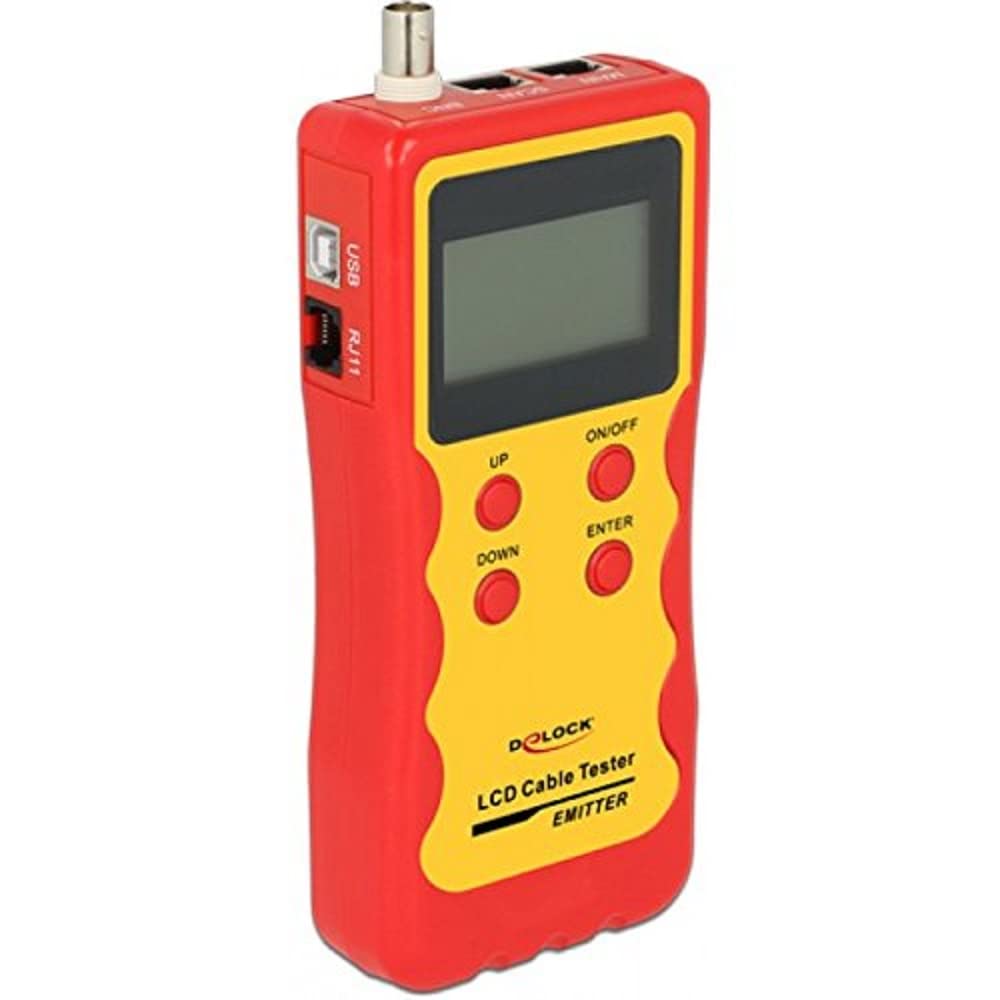
Image Description: A red and yellow Delock 86108 Network Cable Tester main unit, showing the various ports (RJ45, RJ12, BNC, USB) and the LED indicator panel. The device has a robust, handheld design.
Remote Unit
The remote unit detaches from the main unit, allowing for convenient testing of installed cables over longer distances. It typically features corresponding ports to connect the opposite end of the cable being tested.
Gadzirira
Kuiswa kweBattery
- Tsvaga mukamuri yebhatiri kuseri kweiyo main unit.
- Vhura chivharo chebhatiri.
- Insert one 9V battery, ensuring correct polarity (+/-) as indicated inside the compartment.
- Vhara chivharo chebhatiri zvakachengeteka.
Kubatidza/Kudzima
To power on the device, slide the power switch to the "ON" position. The LED indicators will briefly illuminate as a self-test. To power off, slide the switch to the "OFF" position.
Operating Instruction
The Delock 86108 can test various cable types for continuity and correct wiring sequence. Always ensure the tester is powered on before connecting cables for testing.
Testing RJ45/RJ12 Cables
- Connect one end of the RJ45 or RJ12 cable to the corresponding port on the main unit.
- Connect the other end of the cable to the corresponding port on the remote unit. For installed cables, the remote unit can be detached and placed at the other end of the cable run.
- Batidza tester.
- Observe the LED indicators on both the main and remote units. Each LED corresponds to a specific wire. A sequential illumination of LEDs (1-8 for RJ45, 1-6 for RJ12) on both units indicates correct wiring and continuity.
- If an LED does not light up, it indicates an open circuit (broken wire).
- If LEDs light up out of sequence, it indicates a wiring fault (e.g., crossed pairs, short circuit).
Testing BNC Cables
- Connect one end of the BNC cable to the BNC port on the main unit.
- Connect the other end of the BNC cable to the BNC port on the remote unit.
- Batidza tester.
- The LED indicators will show continuity for the center conductor and the shield.
Testing USB Cables
- Connect one end of the USB cable (Type A or B, depending on the tester's ports) to the main unit.
- Connect the other end to the remote unit.
- Batidza tester.
- The LEDs will indicate continuity for the power, data+, data-, and ground lines of the USB cable.
Maintenance
Kuchenesa
Wipe the device with a soft, dry, lint-free cloth. Do not use abrasive cleaners, solvents, or harsh chemicals, as these can damage the casing kana zvikamu zvemukati.
Storage
Store the device in a cool, dry place, away from direct sunlight and extreme temperatures. If the device will not be used for an extended period, remove the battery to prevent potential leakage and damage.
Kugadzirisa matambudziko
Mudziyo haubatike.
- Check if the 9V battery is correctly installed with the proper polarity.
- Ensure the battery has sufficient charge. Replace with a new 9V battery if necessary.
- Verify the power switch is firmly in the "ON" position.
LEDs do not light up or show inconsistent patterns.
- Ensure all cables are securely connected to both the main and remote units. Loose connections can cause false readings.
- Inspect the cable being tested for visible damage, kinks, or frayed connectors.
- Test with a known good cable to verify the tester's functionality. If the known good cable tests correctly, the issue lies with the original cable.
- Replace the battery if the LEDs appear dim, flicker, or behave erratically, indicating low power.
Zvinotsanangurwa
- Muenzaniso: Delock 86108
- Zvinotsigirwa Zvibatanidza: BNC, RJ-12, RJ-45, USB
- Ratidza Rudzi: LED zviratidzo
- Kunobva Simba: 1 x 9V Bhatiri (harina kubatanidzwa)
- Zviyero (L x W x H): 185 mm x 80 mm x 32 mm (7.28 mu x 3.15 mu x 1.26 mukati)
- Kurema 470 magiramu (16.58 oz)
- Muvara Wechigadzirwa: Tsvuku, Yero
Warranty uye Support
For detailed warranty information, technical support, or service inquiries, please refer to the documentation provided with your original purchase or contact your authorized retailer. Please retain your proof of purchase for any warranty claims.


