1. Nhanganyaya
This manual provides essential instructions for the safe and effective operation of the Mustool MT866 Digital True RMS Clamp Meter. The MT866 is a versatile instrument designed for measuring AC/DC voltage, AC/DC current, frequency, temperature, capacitance, resistance, and continuity. It also features a live wire check function and non-contact voltage detection for enhanced safety. Please read this manual thoroughly before using the device.
2. Safety Information
Always adhere to the following safety precautions to prevent personal injury or damage to the meter:
- Do not exceed the maximum input limits for any measurement function.
- Chenjerera zvakanyanya when working with live circuits. High voltagzvinogona kuva nengozi.
- Ensure the test leads are in good condition, without any damage to the insulation.
- Do not operate the meter if it appears damaged or if the battery cover is not properly closed.
- Always disconnect the test leads from the circuit before changing the function dial.
- Use the correct function and range pachiyero chimwe nechimwe.
- Keep fingers behind the finger guards on the test probes during measurements.
- Avoid using the meter in wet environments or in the presence of explosive gases or dust.
- The meter is rated for CAT III 600V and CAT II 600V. Do not use it for measurements exceeding these categories.
3. Chigadzirwa Pamusoroview
The Mustool MT866 is a compact and feature-rich clamp meter. Familiarize yourself with its components:
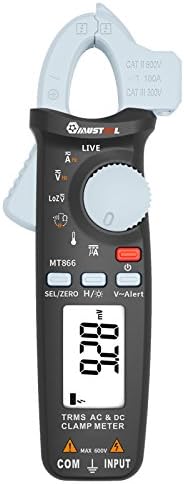
Mufananidzo 1: Mberi View of the Mustool MT866 Clamp Meter. This image displays the main components including the clamp jaw, LCD display, function dial, and control buttons.
3.1. Zvikamu
- Clamp Rushaya: Inoshandiswa pakuyera magetsi eAC/DC asingabatanidzi simba.
- Clamp Chinoburitsa ... Opens the clamp shaya.
- Isiri-Yekubatanidza VoltagSensor ye e (NCV): Inoona AC voltage pasina kuonana kwakananga.
- Chiratidziro cheLCD: Inoratidza kuyerwa kuverenga, mayuniti, uye zviratidzo zvebasa.
- Basa Dial: Selects the desired measurement mode.
- SEL/ZERO Button: Selects sub-functions or zeros the DC current reading.
- H/💡 Button: Activates Data Hold or backlight.
- V~Alert Button: Activates the V~ alert function for live wire detection.
- Input Terminals (COM, INPUT): Yekubatanidza bvunzo inotungamira yevoltage, kuramba, capacitance, frequency, uye tembiricha kuyerwa.
- Back Hook: For convenient hanging of the meter.
3.2. Zviratidzo zvekuratidzira
- AC/DC: Indicates Alternating Current or Direct Current.
- V: Volts (Voltaguye).
- A: Amperes (Current).
- Ω: Ohms (Resistance).
- F: Farads (Capacitance).
- Hz: Hertz (Frequency).
- °C/°F: Degrees Celsius/Fahrenheit (Temperature).
- LIVE: Live wire detection indicator.
- LOZ: Low impedance voltage measurement mode.
- H: Data Hold activated.
- Battery Symbol: Low bhatiri chiratidzo.
4. Setup
4.1. Kuiswa kwebhatiri
The Mustool MT866 requires batteries for operation (not included in the package). To install or replace batteries:
- Ensure the meter is turned off and all test leads are disconnected.
- Tsvaga chivharo chebhatiri kuseri kwemamita.
- Vhura siruu (s) yekuchengeta uye bvisa kavha.
- Insert new batteries, observing the correct polarity (+ and -).
- Tsiva chivharo chebhatiri uye chichengetedze ne screw(s).
4.2. Kubatanidza Test Leads
Pazviyero zvakawanda (voltage, resistance, capacitance, etc.), test leads are required.

Figure 2: Mustool MT866 with Test Leads. The black test lead is connected to the COM terminal, and the red test lead is connected to the INPUT terminal.
- Batanidza iyo black test lead ku COM (common) input terminal.
- Batanidza iyo red test lead ku INPUT terminal.
- Ensure connections are firm before taking any measurements.
5. Operating Instructions
Turn the function dial to the desired measurement mode. Use the SEL/ZERO button to switch between sub-functions (e.g., AC/DC, Resistance/Continuity/Diode).
5.1. AC/DC Voltage Kuyera (V)
- Shandura iyo dial yekushanda kune iyo V chinzvimbo.
- Shandisa iyo SEL/ZERO button to select AC (V~) or DC (V=) voltage.
- Batanidza bvunzo dzinotungamira mukuenderana nedunhu kana chikamu chiri pasi pekuyedzwa.
- Verenga bhukutage kukosha pachiratidziro.
5.2. Low Impedance Voltage (LOZ) Measurement
- Shandura iyo dial yekushanda kune iyo LOZ chinzvimbo.
- This mode automatically detects AC or DC voltage with a low input impedance, which can help drain ghost voltages and provide more accurate readings in certain applications.
- Connect the test leads in parallel to the circuit.
5.3. AC/DC Current Measurement (A) - Clamp
- Shandura iyo dial yekushanda kune iyo A chinzvimbo.
- Shandisa iyo SEL/ZERO button to select AC (A~) or DC (A=) current.
- Dzvanya clamp kusunungura lever kuvhura clamp shaya.
- Enclose only one conductor of the circuit within the clamp shaya.
- For DC current, press SEL/ZERO to zero the reading before measurement if necessary.
- Verenga kukosha kwazvino kuri pachiratidziro.
5.4. Resistance (Ω), Continuity, Diode Test
- Shandura iyo dial yekushanda kune iyo Ω chinzvimbo.
- Shandisa iyo SEL/ZERO button to cycle between Resistance, Continuity, and Diode Test modes.
- Resistance: Connect test leads across the component. Ensure the circuit is de-energized.
- Kuenderera mberi: If resistance is below approximately 30Ω, the buzzer will sound.
- Diode Bvunzo: Connect the red lead to the anode and black lead to the cathode. The display shows the forward voltagkudonha. Dzosa mawaya kuti utarise kana circuit yakavhurika.
5.5. Capacitance (µF) Measurement
- Shandura iyo dial yekushanda kune iyo µF chinzvimbo.
- Discharge the capacitor completely before connecting the test leads.
- Batanidza bvunzo inotungamira mhiri kwecapacitor terminals.
- Verenga iyo capacitance kukosha pane inoratidzwa.
5.6. Frequency (Hz) Measurement
- Frequency can be measured from the jaw (when in AC current mode) or from the input terminals (when in AC voltage mode).
- When in ACV or ACA mode, press the SEL/ZERO button to cycle to the frequency measurement.
- Connect the test leads or clamp the conductor as appropriate for the primary measurement.
5.7. Temperature (°C/°F) Measurement

Figure 3: Mustool MT866 with Temperature Probe. The temperature probe is connected to the input terminals for temperature measurements.
- Shandura iyo dial yekushanda kune iyo TEMP chinzvimbo.
- Connect the temperature test probe to the input terminals (red to INPUT, black to COM).
- Isa panoperera tembiricha pachinhu kana pedyo nechinhu chinoyerwa tembiricha.
- Read the temperature on the display. Use SEL/ZERO kuchinja pakati peCelsius neFahrenheit.
5.8. Live Wire Check (LIVE)
- Shandura iyo dial yekushanda kune iyo LIVE chinzvimbo.
- Insert the red test lead into the live wire socket. The display will show "LIVE" and an alarm will sound if a live wire is detected.
5.9. Vasina-Kubata Voltage (V~Alert) Detection
- Press the V~Alert bhatani rekuti ushandise NCV mode.
- Move the top of the meter (where the NCV sensor is located) close to a conductor or outlet.
- Kana AC voltage is detected, the meter will beep and the LED indicator will flash, with the intensity increasing sevhoriyamutagSimba rinowedzera.
5.10. µA HVAC Flame Rod Test
- Shandura iyo dial yekushanda kune iyo .A chinzvimbo.
- This function is specifically designed for measuring microamperes in HVAC flame rod applications (0-200.0µA).
- Connect the test leads in series with the flame rod circuit.
5.11. Data Hold (H) and Backlight (💡)
- Press the H/💡 button briefly to activate Data Hold, freezing the current reading on the display. Press again to release.
- Dzvanya uye ubate iyo H/💡 bhatani rekubatidza kana kudzima backlight.
6. Kuchengeta
6.1. Kuchenesa
- Pukuta mita yacho neadamp jira uye nyoro detergent. Usashandise abrasives kana solvents.
- Ensure the meter is completely dry before use.
6.2. Kutsiviwa kwebhatiri
When the battery symbol appears on the display, replace the batteries as described in Section 4.1. Prompt battery replacement ensures accurate readings and proper device function.
6.3. Kuchengeta
- If the meter is not used for an extended period, remove the batteries to prevent leakage.
- Store the meter in a cool, dry place, away from direct sunlight and extreme temperatures.
7. Kugadzirisa matambudziko
| Dambudziko | Zvinogona Kukonzera | Solution |
|---|---|---|
| Hapana kuratidza kana dim kuratidza | Mabhatiri akaderera kana akafa; kuiswa kwebhatiri kusina kunaka. | Dzorera mabhatiri; tarisa bhatiri polarity. |
| "OL" kana "OVER" zvinoratidzwa | Measurement exceeds the selected range. | Select a higher range or check if the input is too high for the meter. |
| Kurava kusina kururama | Poor test lead connection; incorrect function/range selected; external interference. | Ensure firm connections; select appropriate function/range; move away from strong electromagnetic fields. |
| Hapana kurira kwekuenderera mberi | Circuit resistance too high; continuity mode not selected. | Ensure resistance is below 30Ω; press SEL/ZERO to select continuity mode. |
8. Zvinotsanangurwa
The following are the general specifications for the Mustool MT866 Digital True RMS Clamp Meter:
- Max. Display: 6000 kuverenga
- AC Current (ACA): 6A/60A/100A (±2.5%+5)
- DC Current (DCA): 6A/60A/100A (±2.5%+5)
- AC Voltage (ACV): 6V/60V/600V (±1%+3)
- DC Voltage (DCV): 6V/60V/600V (±1%+3)
- Low Impedance Voltage (LoZ ACV-DCV Auto Scan): 600.0V / 300kΩ input impedance
- Resistance (OHM): 600Ω/6KΩ/60KΩ/600KΩ/6MΩ/60MΩ (±1%+3)
- Capacitance: 600.0µF/6000µF (±4%+3)
- Kakawanda (Hz): 60Hz/1000Hz (from jaw or input terminals)
- Tembiricha: -20 ~ 500 ° C / -4 ~ 932 ° F
- µA HVAC Flame Rod Test: 0~200.0µA
- Chinoburitsa Mashoko Chekuenderera Mberi: isingasviki 30Ω
- Style: Digital
- Chiyero chemhando: Multimeter
- Safety Rating: CAT III 600V, CAT II 600V
9. Package Zviri mukati
The Mustool MT866 package typically includes the following items:
- 1 x Mustool MT866 Digital True RMS Clamp Meter (Batteries are not included)
- 1 x Pair Test Probe (Red and Black)
- 1 x 1M (Length) Temperature Test Probe
- 1 x English User Manual (This document)
10. Warranty uye Tsigiro
Kuti uwane ruzivo rwewarandi, rutsigiro rwehunyanzvi, kana mibvunzo yebasa, ndapota tarisa magwaro akapihwa panguva yekutenga kana kubata mutengesi wako. Chengeta risiti yako yekutenga sehumbowo hwekutenga.


