1. Nhanganyaya
This manual provides comprehensive instructions for the installation, operation, and maintenance of the Afriso Thermostatic Radiator Head Type 320 N. This head is specifically designed for use with Gampper clamp connection valve bodies manufactured between 1980 and 1998. It also serves as a direct replacement for older Afriso models 313 and 314.
2. Mirayiridzo Yekuchengetedza
- Ensure the heating system is depressurized and cooled before attempting any installation or maintenance procedures.
- Kana iwe usina chokwadi pamusoro pekugadzirisa maitiro, zvinokurudzirwa kutsvaga rubatsiro kubva kune unyanzvi hunobudirira.
- Do not expose the thermostatic head to ambient temperatures exceeding 50 °C.
- Keep the product out of reach of children to prevent accidental damage or misuse.
3. Chigadzirwa Pamusoroview
The Afriso Thermostatic Radiator Head Type 320 N is a precision-engineered control head that utilizes a liquid sensor to regulate room temperature by modulating the flow of hot water through a radiator. Its robust design ensures reliable performance and energy efficiency.
Zvinokosha:
- Sensor yemvura: Highly responsive to ambient temperature changes for accurate control.
- Zero Position: Allows for complete shut-off of the radiator, useful during warmer periods or for maintenance.
- Adjustable Economy Position: Enables setting a specific energy-saving temperature.
- Limitation Ring: Provides the ability to limit and lock the minimum and maximum temperature adjustment range.
- Material: Constructed from durable plastic for longevity.
- Connection: Features a Gampper clamp connection for secure and compatible fitting.

Figure 1: The Afriso Thermostatic Radiator Head Type 320 N, showing the temperature scale (0 to 5, with snowflake and wave symbols) and the Afriso logo. Two small red and blue plastic clips, used for limiting the temperature range, are also visible.

Figure 2: The product packaging for the Afriso Thermostat Control Head, displaying the brand 'Afriso' and the model '323 N' along with 'THERMOSTAT CONTROL HEAD' in English.
4. Setup uye Kuiswa
Installation Instruction:
- Kugadzirira: Verify that your radiator valve body is compatible with a Gampper clamp connection. This head is designed for valve bodies manufactured between 1980 and 1998.
- Bvisa Musoro Wekare (kana zvichibvira): If replacing an existing thermostatic head, carefully remove it according to its manufacturer's instructions.
- Positioning: Align the new Afriso Thermostatic Radiator Head with the valve body. The head features a specific Gampper clamp connection mechanism.
- Kuchengetedza: Gently push the thermostatic head onto the valve body. Ensure it is properly seated and then secure it firmly using the clamp connection. No tools are typically required for this step.
- Kutanga Setting: Once installed, set the head to your desired initial temperature.

Mufananidzo 3: Kuvhara view of the bottom of the Afriso Thermostatic Radiator Head, illustrating the Gampper clamp connection mechanism. The knurled metal ring and the internal structure for attachment to the radiator valve are clearly visible.

Mufananidzo 4: Rutivi view of the thermostatic head, clearly displaying the 'Gampper' label and the clamp connection. The temperature scale and the internal liquid sensor mechanism are also visible.
5. Operating Instructions
The thermostatic head efficiently regulates the room temperature by automatically adjusting the flow of hot water through the radiator based on the ambient temperature.
Kugadzirisa Tembiricha:
- Kuisa Tembiricha Yaunoda: Rotate the handwheel on the thermostatic head to align the desired room temperature setting with the indicator mark. The scale typically ranges from '0' (off/frost protection) to '5' (maximum heat).
- Frost Protection (Snowflake Symbol): Setting the head to the snowflake symbol (often found between '0' and '1') activates frost protection. This maintains a minimum temperature in the room to prevent pipes from freezing, typically around 6-8 °C.
- Economy Position: Utilize the adjustable economy position to set a specific energy-saving temperature, which can help reduce heating costs.
- Limiting the Range: If desired, use the provided limitation ring (often consisting of red and blue clips, as shown in Figure 1) to restrict the minimum and maximum temperature settings. This prevents accidental changes outside a preferred range.
The integrated liquid sensor continuously monitors the ambient room temperature. If the room temperature falls below the set value, the valve automatically opens further to allow more hot water into the radiator, increasing heat output. Conversely, if the room temperature exceeds the set value, the valve closes, reducing the heat output and maintaining the desired temperature.
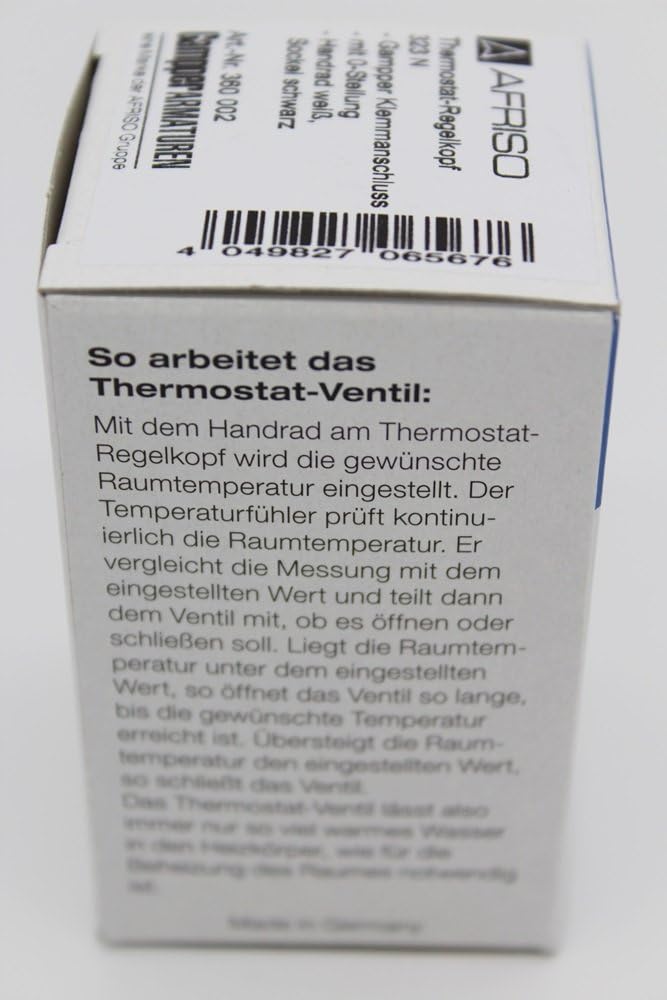
Figure 5: A section of the product packaging displaying German text that explains the operational principle of the thermostat valve. It details how the handwheel sets the desired room temperature and how the temperature sensor continuously monitors and adjusts the valve to maintain this setting.
6. Kuchengeta
Kuchengeta uye Kuchenesa:
- Kuchenesa: To clean the thermostatic head, simply wipe it with a soft, damp cloth. Avoid using abrasive cleaners, solvents, or harsh chemicals, as these can damage the plastic surface.
- Dzivisa Kuvhiringidza: Ensure that the thermostatic head's sensor is not covered by curtains, furniture, or any other objects. Obstructions can impair the sensor's ability to accurately read the ambient room temperature, leading to inefficient heating.
- No Internal Maintenance: The Afriso Thermostatic Radiator Head is a sealed unit and does not require any internal maintenance. Do not attempt to disassemble the head, as this will void any warranty and may damage the unit.
7. Kugadzirisa matambudziko
Matambudziko Anowanikwa uye Mhinduro:
| Dambudziko | Zvinogona Kukonzera | Solution |
|---|---|---|
| Radiator haisi kupisa | Thermostatic head set to '0' or frost protection; valve pin stuck; air trapped in radiator. | Turn the head to a higher setting; gently press the valve pin to free it; bleed the radiator to release trapped air. |
| Room is too hot or too cold | Incorrect temperature setting; sensor obstructed; faulty thermostatic head. | Adjust the temperature setting; ensure the sensor is clear of obstructions; if persistent, the head may need replacement. |
| Thermostatic head is difficult to turn | Internal mechanism has become stiff or dirty. | Gently try to turn the head through its full range of motion a few times. If stiffness persists, consider replacing the head. |
For issues not listed above or if the problem persists after attempting these solutions, please contact customer support for further assistance.
8. Zvinotsanangurwa
Technical Data:
- Brand: Afriso
- Muenzaniso: Type 320 N
- Kuenderana: Gampper clamp connection valve bodies (manufactured 1980-1998)
- Sensor Type: Liquid sensor
- Maximum Ambient Temperature: 50 °C
- Material: Plastiki
- Ruvara: Chena
- Package Dimensions: 9.4 x 5.5 x 5.5 cm
- Package Weight: 156 magiramu
- Mugadziri Chikamu Nhamba: 360 002
- EAN/UPC: 4049827065676
- Type Power Source: Manually powered
- Zvinosanganisirwa Zvikamu: Thermostatic musoro
- Mabhatiri Anodiwa: Aihwa
9. Warranty uye Tsigiro
For detailed warranty information, technical support, or to inquire about spare parts, please refer to the official Afriso website or contact your authorized retailer. It is advisable to retain your purchase receipt as proof of purchase for any warranty claims.
- Mugadziri: Afriso
- Model Number: 360 002
- ASIN: B07DX13SP8


