1. Safety Information
Yambiro: Not suitable for children under 3 years. Contains small parts that could be swallowed.
Always operate the vehicle in a safe environment, away from people, pets, and obstacles. Do not operate near public roads or water bodies. Adult supervision is recommended for younger users.
2. Nhanganyaya
The Amewi Climbing Beast 22529 is a 1:10 scale 4WD remote-controlled crawler designed for off-road use. It features a powerful motor, oversized tires, and bright LED lighting for visibility in low-light conditions. The vehicle's plastic frame is engineered to absorb impacts, while metal ball bearings, splash-proof electronics, and shock absorbers with metal springs contribute to its durability and performance. The 2.4 GHz pistol-grip remote control provides precise and responsive handling, allowing multiple vehicles to operate simultaneously without interference. This model comes Ready-to-Run (RTR), with all necessary components and batteries included.
3. Package Zviri mukati
Ita shuwa kuti zvinhu zvese zvakanyorwa pazasi zviripo mupakeji yako:
- Amewi Climbing Beast 22529 Crawler (Ready-to-Run)
- 2.4 GHz Pistol-Grip Remote Control
- 7.4 V 1500 mAh Lithium-Ion Battery
- USB Kuchaja Cable
- 4 x AA Mignon 1.5 V Batteries (for remote control)
- 12 x Spare Body Pins
- Instruction Manual (German/English)

Image: The Amewi Climbing Beast 22529 Crawler, its 2.4 GHz remote control, and included accessories, displayed with the product packaging.
4. Zvigadzirwa zveChigadzirwa
- Oversized TPR Rubber Tires: Designed for maximum grip on various terrains including mud, rocky paths, and sand.
- Metal Ball Bearings: Ensures smoother operation and reduced wear on all drive components.
- Steel Suspension System: Provides precise chassis movement and maximum traction on uneven terrain.
- Sisitimu Yepamusoro Yekumisa: Enhances off-road performance and stability.
- Splash-Proof Electronics: Protects internal components from water splashes.
- Collision-Resistant Frame: Durable plastic frame designed to absorb impacts.
- Adjustable Steering Trim: Allows fine-tuning of steering for straight tracking.
- Front and Rear LED Lighting: Improves visibility during low-light operation.
- Kumhanya Kwepamusoro: Approximately 15 km/h.
- 2.4 GHz Pistol-Grip Remote Control: Offers precise control and allows multiple vehicles to operate simultaneously.
- Proportional Steering uye Throttle: Provides adjustable and responsive control over speed and direction.
- Roof Rack: Functional roof rack for carrying small items.
- 4-Wheel Drive (4WD): Ensures superior traction and climbing capability.
5. Setup
5.1 Vehicle Battery Installation and Charging
- Carefully remove the vehicle's body shell by detaching the body pins.
- Tsvaga nzvimbo yebhatiri.
- Connect the included 7.4 V 1500 mAh Li-Ion battery to the vehicle's ESC (Electronic Speed Controller) connector.
- Place the battery securely in the battery compartment.
- To charge the battery, disconnect it from the vehicle. Connect the battery to the USB charging cable. Plug the USB cable into a suitable USB power source (e.g., computer USB port, USB wall adapter). The charging time is approximately 180-240 minutes. Do not leave charging unattended.
- Once charged, disconnect the battery from the charger and reconnect it to the vehicle. Replace the body shell and secure it with the body pins.

Image: The vehicle's chassis showing the battery securely placed in its compartment.

Image: The included USB charging cable, AA batteries for the remote control, and the 7.4V Li-Ion battery for the vehicle.
5.2 Remote Control Battery Kuiswa
- Open the battery compartment cover on the bottom of the 2.4 GHz remote control.
- Insert the 4 x AA Mignon 1.5 V batteries, ensuring correct polarity (+/-).
- Vhara chivharo chebhatiri zvakachengeteka.

Image: The 2.4 GHz pistol-grip remote control, showing its various controls and ergonomic design.
5.3 Kubatanidza Remote Control
The vehicle and remote control are typically pre-paired from the factory. If re-pairing is necessary:
- Ensure both the vehicle battery and remote control batteries are fully charged and correctly installed.
- Turn on the remote control first. The indicator light should flash.
- Turn on the vehicle. The indicator light on the vehicle's receiver should also flash.
- Wait a few seconds. The indicator lights on both the remote control and the vehicle should become solid, indicating a successful connection.
- If pairing fails, turn off both devices and repeat the process.
6. Kushanda
6.1 Basic Controls
- Chidhiraivho: Rotate the steering wheel on the remote control left or right to steer the vehicle.
- Throttle Trigger: Pull the trigger towards you to move forward. Push the trigger away from you to brake or reverse.
- Steering Trim (ST.TRIM): Adjust this dial to ensure the vehicle drives straight when the steering wheel is centered.
- Throttle Trim (TH.TRIM): Adjust this dial to ensure the vehicle remains stationary when the throttle trigger is in the neutral position.
- Kuchinja Kwemagetsi (KUVAMBIRA/KUDZIMWA): Inobatidza kana kudzima remote control.
Image: The remote control, highlighting the steering wheel, throttle trigger, and trim adjustments.
6.2 Driving Guidelines
- Start by practicing in an open, clear area to get accustomed to the controls.
- Avoid driving in deep water, as while the electronics are splash-proof, the vehicle is not fully waterproof.
- Be mindful of the vehicle's range (approximately 60 meters) to maintain control.
- The LED lights can be used for driving in low-light conditions, but ensure sufficient visibility for safe operation.
- When driving on challenging terrain, use gentle throttle and steering inputs to maintain traction and avoid rollovers.
7. Kuchengeta
7.1 Kuchenesa
- After each use, especially after driving in dirt or mud, clean the vehicle.
- Use a soft brush or compressed air to remove loose dirt and debris from the chassis, wheels, and suspension components.
- Wipe down the body shell with a damp jira. Dzivisa kushandisa makemikari ane hasha kana zvinonyungudutsa.
7.2 Kuchengeta
- Always remove the batteries from both the vehicle and the remote control before storing.
- Store the vehicle in a cool, dry place, away from direct sunlight and extreme temperatures.
- Ensure the Li-Ion battery is stored at a partial charge (around 50%) for optimal longevity.
7.3 Component Care
- Metal Ball Bearings: Periodically inspect and clean the metal ball bearings. Lubricate them with appropriate RC bearing oil if necessary to ensure smooth operation and prevent wear.
- Splash-Proof Electronics: While designed to resist splashes, avoid submerging the vehicle in water. If the electronics get wet, allow them to dry completely before operating again.
- Kumiswa: Check the shock absorbers and springs for any damage or debris that might hinder their movement.
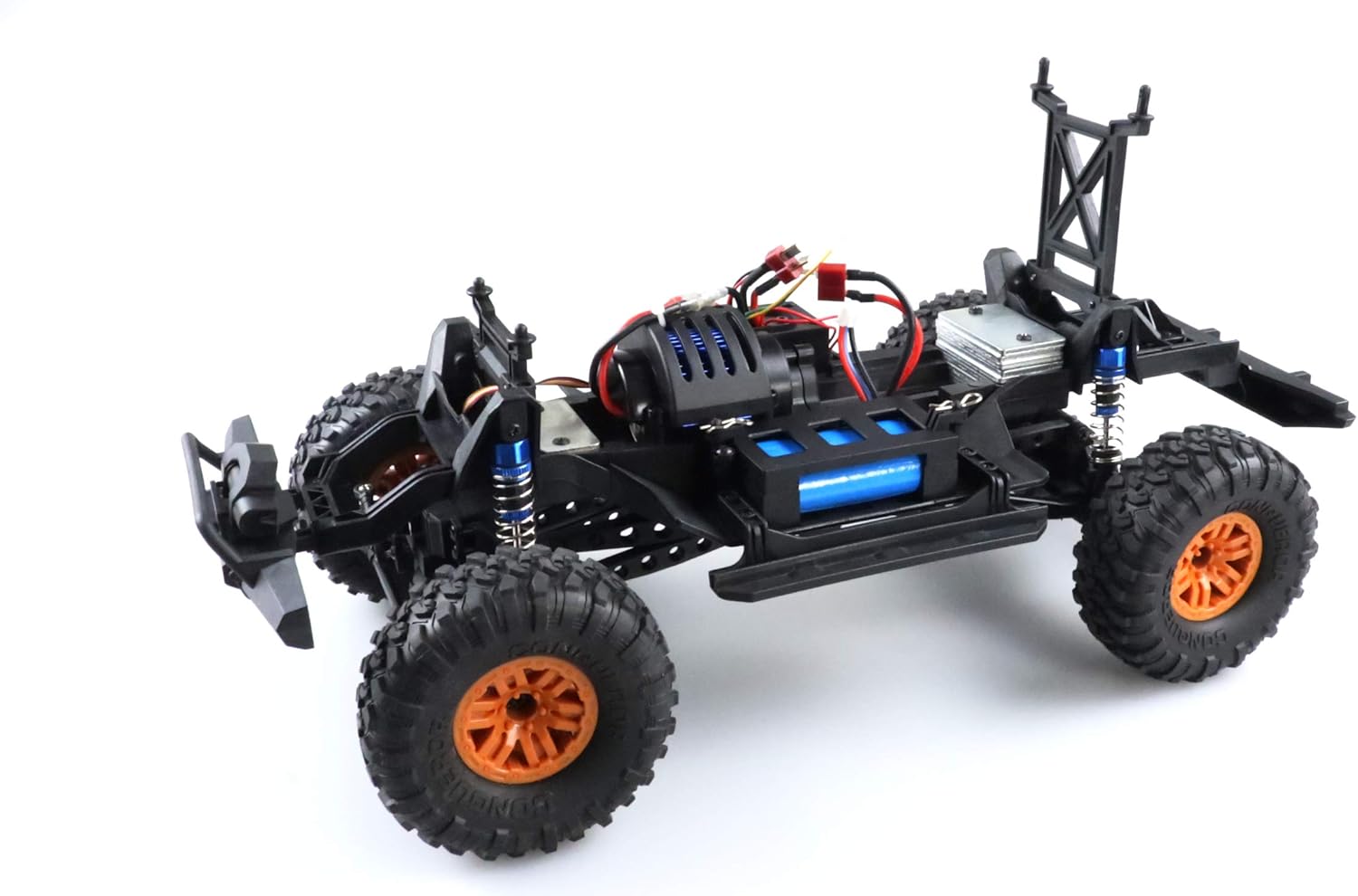
Image: The vehicle's chassis, illustrating the suspension, wheels, and drive components.

Mufananidzo: Yakadzama view of the vehicle's internal electronics, including the ESC and wiring.
8. Kugadzirisa matambudziko
| Dambudziko | Zvinogona Kukonzera | Solution |
|---|---|---|
| Mota haipindure kana yaiswa kure. | Low battery in vehicle or remote control; Not paired; Power switch off. | Charge/replace batteries; Re-pair remote control and vehicle; Ensure power switches are ON. |
| Vehicle drives erratically or loses signal. | Out of range; Interference; Low battery. | Bring vehicle closer to remote control; Avoid areas with strong interference; Charge/replace batteries. |
| Motokari haityai yakatwasuka. | Kugadzirisa dhiraivha kunoda kugadziriswa. | Adjust the ST.TRIM dial on the remote control until the vehicle tracks straight. |
| Vehicle moves slightly when throttle is neutral. | Throttle trim needs adjustment. | Adjust the TH.TRIM dial on the remote control until the vehicle remains stationary. |
| Yakaderedzwa nguva yekumhanya. | Battery not fully charged; Old battery; Heavy driving conditions. | Ensure battery is fully charged; Consider replacing old battery; Drive more conservatively. |
9. Zvinyorwa zveUnyanzvi
| Feature | Tsanangudzo |
|---|---|
| Scale | 1:10 |
| Urefu | 475 mm |
| Upamhi | 200 mm |
| Urefu | 235 mm |
| Kurema (incl. Bhatiri) | 2055 g |
| Wheelbase | 255 mm |
| Track Width (Front/Rear) | 170 mm |
| Ground Clearance | 27 mm |
| Wheels (Front/Rear) | 96/35 mm |
| Rim Diameter | 44 mm |
| Brake | Electronic |
| Controller | All-in-One unit |
| Motor | 540 Brushed |
| Dhiraivha System | 4WD |
| Kutungamira Servo | Midi size 5-pin |
| Main Material | Plastiki |
| Battery Compartment Dimensions | 69 x 35 x 17 mm |
| Bhatiri reMotokari | Li-Ion, 2S, 7.4 V 1500 mAh, Dean connector |
| Vehicle Battery Dimensions | 68 x 34 x 16 mm |
| Vehicle Battery Weight | 87 g |
| Battery Balance Connector | XH |
| Run Time | Approx. 20 min |
| Max Speed | Approx. 15 km/h |
| Remote Control Type | Pistol-grip, 2.4 GHz |
| Remote Control Range | 60 m |
| Charger | USB yekuchaja tambo |
| Kuchaja Nguva | 180-240 min |
| Yakakurudzirwa Zera | 8 makore zvichikwira |
| Color | Dema/Orenji |
10. Warranty uye Tsigiro
For warranty information and technical support, please refer to the contact details provided by your retailer or the manufacturer's official website. Keep your proof of purchase for any warranty claims. Information regarding spare parts availability is not provided in this manual.


