Nhanganyaya
This manual provides essential instructions for the safe and effective operation, maintenance, and troubleshooting of your TOPTES PT520A Gas Detector and Guard-101 4-Gas Monitor. This bundle offers comprehensive gas safety solutions for both residential and professional environments.
The PT520A is designed for quickly detecting combustible gases such as methane, propane, and LPG, featuring a flexible gooseneck probe for accessing confined spaces. The Guard-101 is a multi-gas monitor capable of accurately detecting Hydrogen Sulfide (H₂S), Carbon Monoxide (CO), Lower Explosive Limit (LEL) of combustible gases, and Oxygen (O₂). Both devices incorporate visual and audible alarms to ensure immediate alerts in the event of gas leaks or hazardous conditions.
Chii Inosanganisirwa
- 1 × TOPTES PT520A Gas Leak Detector
- 1 × TOPTES Guard-101 4-Gas Monitor
- Mushandisi Chinyorwa (gwaro iri)
- Charging cables (specific to each device, if applicable)
- Other accessories as specified on product packaging
Safety Information
Read all instructions carefully before use. Failure to follow safety guidelines may result in injury, property damage, or inaccurate readings.
- Mamiriro Ekukuvadza: Do not use the devices in environments exceeding their specified operating conditions (temperature, humidity, gas concentration).
- Dambudziko rekuputika: The Guard-101 is designed to be explosion-proof. However, always exercise caution when detecting combustible gases. Do not operate the PT520A in areas with high concentrations of flammable gases where ignition sources are prohibited.
- Calibration: Regular calibration is essential for accurate gas detection. Refer to the maintenance section for details.
- Kuchengetedzwa kweBhatiri: Use only specified chargers and batteries. Do not expose batteries to extreme temperatures or physical damage.
- Kupindira: Keep devices away from strong electromagnetic fields, which can affect performance.
- Midziyo yekurapa: Consult a physician before using these devices if you have an implanted medical device.
- Kushandiswa Kwehunyanzvi: For industrial or professional applications, ensure compliance with all local safety regulations and standards.
- Alarm Mhinduro: Never ignore alarms. Immediately follow established safety protocols when an alarm is triggered.
Product Overview
Guard-101 4-Gas Monitor
The Guard-101 is a robust, multi-gas monitor designed for continuous monitoring of H₂S, CO, LEL, and O₂. It features a high-strength ABS construction, making it waterproof, dustproof, and explosion-proof. The device includes a convenient back clip for portability.

Mufananidzo: The Guard-101 monitor displaying real-time readings for Oxygen (O₂), Lower Explosive Limit (LEL), Carbon Monoxide (CO), and Hydrogen Sulfide (H₂S). The device is shown with a protective shield graphic, emphasizing safety.
Zvinokosha:
- Simultaneous detection of H₂S, CO, LEL, and O₂.
- Triple alarm system: Visual, Audible, and Vibration.
- Automatic alarm record storage.
- Durable, high-strength ABS construction.
- Long battery life (up to 14 hours with 2000mAh capacity).

Mufananidzo: The Guard-101's display showing an alarm record with date and time. Below, three icons represent the visual, audible, and tactile (vibration) alarm types, indicating comprehensive alert capabilities.

Mufananidzo: The Guard-101 device highlighted with text indicating a 2000mAh battery capacity and a 14-hour battery life, emphasizing its extended operational duration.

Mufananidzo: A worker wearing the Guard-101 device clipped to their uniform, illustrating its portability and ease of carrying with the integrated back clip. The image also highlights its waterproof, dustproof, and explosion-proof features.
PT520A Gas Detector
The PT520A is a specialized detector for combustible gases, featuring a flexible gooseneck probe for precise leak location. It provides visual and audible alerts to indicate gas concentration levels.
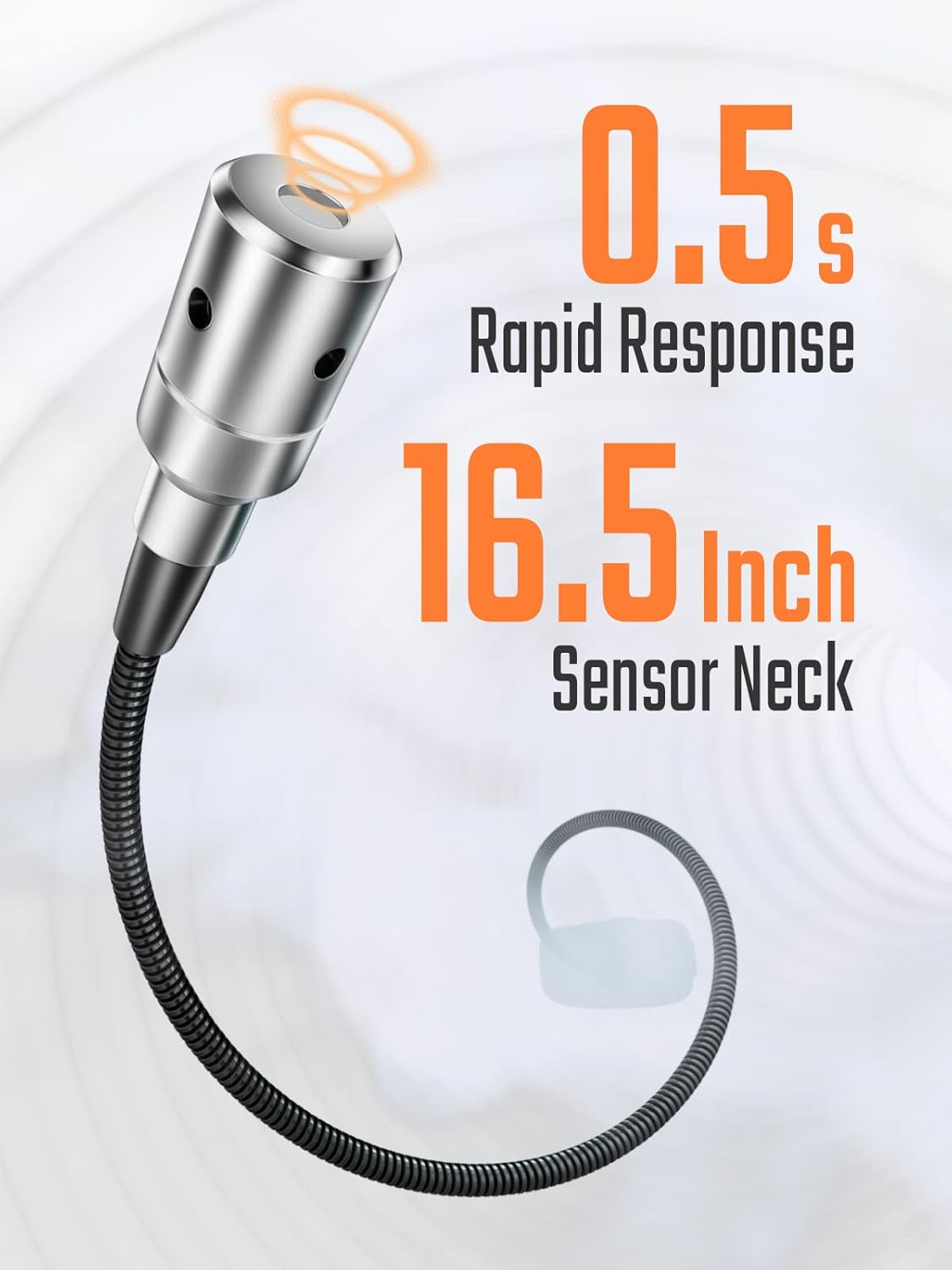
Mufananidzo: The PT520A's flexible gooseneck sensor, highlighting its 0.5-second rapid response time and 16.5-inch length, designed for reaching difficult areas.
Zvinokosha:
- Detects methane, propane, LPG, and other combustible gases.
- 17-inch flexible gooseneck probe for hard-to-reach areas.
- Visual (seven colored bars) and audible (75dB buzzer) alerts.
- Auto power-off basa.
- Mute function for audible alarms.
- Non-slip design.

Mufananidzo: The PT520A detector's display indicating visual and audible alarms. Text highlights the user-friendly design with a press-to-mute function for the audible alarm.

Mufananidzo: The PT520A's LCD color backlight display, showing gas concentration levels with colored bars (SENS-L, SENS-M, SENS-H), indicating easy readability even in low-light conditions.

Mufananidzo: The PT520A detector shown in various application scenarios, including inspecting a gas pipeline, an RV propane tank, a gas stove, and a water heater, demonstrating its wide range of uses for locating combustible gases.
Gadzirira
Kutanga Kuchaja
Before first use, fully charge both the PT520A and Guard-101 devices. Connect the provided charging cables to the respective charging ports and a suitable USB power adapter. The charging indicator will typically change color or status when charging is complete.
Simba On/Kudzima
- Kubatidza: Press and hold the power button on each device until the display illuminates. Both devices will typically perform a self-test sequence upon startup.
- Kudzima: Dzvanya uye bata bhatani remagetsi kusvika mudziyo wadzima.
Self-Test and Warm-up
Upon powering on, both devices will undergo a brief self-test and warm-up period. During this time, the sensors stabilize. Do not use the devices for detection until the warm-up sequence is complete and they indicate readiness (e.g., "WAIT" message disappears, stable readings appear).
Operating Instruction
Using the PT520A Gas Detector (Combustible Gases)
- Power On: Turn on the PT520A and allow it to complete its warm-up cycle.
- Gadzirisa Sensitivity: The PT520A may have adjustable sensitivity levels (Lo, Mid, Hi). Select the appropriate sensitivity based on the expected gas concentration or the area being inspected. Start with a lower sensitivity for general area checks and increase for pinpointing leaks.
- Scan nzvimbo: Slowly move the flexible gooseneck probe into the area where a gas leak is suspected. Pay close attention to gas pipelines, connections, appliances, and enclosed spaces.
- Interpret Alarms:
- Alarm yekuona: The LED bar graph on the display will illuminate with colored bars, indicating increasing kuwanda kwegasi.
- Inonzwika Alarm: A 75dB buzzer will sound, increasing in frequency or intensity with higher gas levels.
- Pinpoint Leak: When an alarm is triggered, move the probe slowly around the area to identify the highest concentration point, which indicates the leak source.
- Mute Basa: Press the mute button to temporarily silence the audible alarm if needed, while the visual alarm remains active.
- Auto Power-Kudzima: The device may automatically power off after a period of inactivity to conserve battery.
Using the Guard-101 4-Gas Monitor (H₂S, CO, LEL, O₂)
- Power On: Turn on the Guard-101 and allow it to complete its warm-up and self-test. Ensure the display shows stable readings for all four gases.
- Tarisa Nzvimbo: Carry the Guard-101 with you in the environment to be monitored. The back clip allows for easy attachment to clothing.
- Real-time Readings: The display will show real-time concentrations for H₂S, CO, LEL, and O₂. Familiarize yourself with safe exposure limits for each gas.
- Alarm Mhinduro:
- Alarm yekuona: The screen will flash, and indicator lights will activate.
- Inonzwika Alarm: A loud buzzer will sound.
- Alarm yeVibration: Chishandiso chichadedera.
- These alarms will persist until gas levels return to normal or are manually acknowledged/cleared.
- Review Alarm Records: The Guard-101 stores alarm events. Refer to the device's menu (if applicable) to access and review past alarm records, including time and gas levels.
Maintenance
Kuchenesa
- Pukuta kunze kwemidziyo yese ne soft, damp jira. Usashandise abrasive cleaners kana solvents.
- Ensure the sensor openings are free from dust and debris. Do not attempt to clean internal components.
Calibration
Regular calibration is critical for maintaining the accuracy and reliability of gas detectors. The frequency of calibration depends on usage, environmental conditions, and regulatory requirements. For the Guard-101, professional calibration is recommended periodically (e.g., every 6-12 months) or as required by local standards. The PT520A typically performs a self-calibration upon startup, but if readings appear inaccurate, consult the manufacturer for service.
Battery Care
- Charge devices fully before extended storage.
- Dzivisa kubvisa zvachose bhatiri nguva nenguva.
- Chengeta zvishandiso munzvimbo inotonhorera, yakaoma kana zvisiri kushandiswa.
Kugadzirisa matambudziko
| Dambudziko | Zvinogona Kukonzera | Solution |
|---|---|---|
| Mudziyo haubatike. | Bhatiri rakaderera kana rapera. | Chaja mudziyo zvizere. |
| Inaccurate gas readings. | Sensor contamination; device needs calibration; environmental interference. | Clean sensor area; perform calibration (Guard-101) or contact support (PT520A); move away from interference sources. |
| Alarms not sounding (PT520A). | Mute function activated; low battery. | Deactivate mute; charge battery. |
| Guard-101 alarms constantly. | High gas concentration in the environment. | Evacuate the area immediately and follow safety protocols. Do not re-enter until the area is confirmed safe. |
| PT520A shows "WAIT" indefinitely. | Sensor warm-up issue or fault. | Power off and restart the device. If the issue persists, contact customer support. |
Zvinotsanangurwa
TOPTES PT520A Gas Detector
- Magasi Akaonekwa: Methane, Propane, LPG, Natural Gas, Sewer Gas, Gasoline, etc. (Combustible gases)
- Nguva Yemhinduro: Anenge 0.5 seconds
- Probe Length: 17 inches (flexible gooseneck)
- Alamu: Visual (7 colored bars), Audible (75dB buzzer)
- Features: Auto power-off, Mute function, Non-slip design
TOPTES Guard-101 4-Gas Monitor
- Magasi Akaonekwa: H₂S (Hydrogen Sulfide), CO (Carbon Monoxide), LEL (Lower Explosive Limit), O₂ (Oxygen)
- Alamu: Visual, Audible, Vibration (Triple Alarm System)
- Kuvaka: High-strength ABS, Waterproof, Dustproof, Explosion-proof
- Bhatiri: 2000mAh kugona
- Hupenyu hwebhatiri: Kusvikira kumaawa makumi maviri nemashanu
- Kuchengeta Data: Stores alarm records
- Zvitupa: Professionally certified (meets international safety standards)
Note: Specifications are subject to change without notice. For the most current information, please refer to the product packaging or manufacturer's website.
Warranty uye Support
TOPTES products are designed for reliability and performance. This product is covered by a manufacturer's warranty against defects in materials and workmanship. The specific terms and duration of the warranty may vary. Please refer to the warranty card included with your product or visit the official TOPTES websaiti yeruzivo rwakadzama nezvewarandi.
For technical support, troubleshooting assistance, or warranty claims, please contact TOPTES customer service through their official website or the contact information provided on your product packaging. When contacting support, please have your product model number (PT520A, Guard-101) and purchase information ready.
Official TOPTES Websaiti: Visit the TOPTES Store on Amazon (for general product information and store access)


