1. Nhanganyaya
The Fudajo Fully Automatic Incubator is designed to provide optimal conditions for hatching eggs from various poultry species. With a capacity of up to 64 eggs, this incubator is suitable for chickens, ducks, geese, pigeons, or quails. It features advanced technology for precise temperature control, efficient humidity regulation, and automatic egg turning, ensuring a high success rate for your incubation process.
2. Mirayiridzo Yekuchengetedza
- Always read all instructions before operating the incubator.
- Ensure the incubator is placed on a stable, level surface away from direct sunlight, drafts, or extreme temperature fluctuations.
- Do not immerse the incubator or any electrical components in water or other liquids.
- Chengetedza kure nevana nemhuka dzinovaraidza.
- Unplug the incubator from the power outlet before cleaning or performing any maintenance.
- Shandisa chete yakapihwa simba adapta uye tambo.
- In case of power failure, the emergency battery cable can be used to connect to a 12V battery (not included) to maintain operation.
3. Package Zviri mukati
Ndokumbira utarise zvirimo pasuru pawatambira kuti uone kuti zvinhu zvese zviripo uye hazvina kukuvara:
- Fudajo Fully Automatic Incubator Unit
- Power Cable (AC)
- Emergency Battery Cable (DC)
- Water Bottle Connection Parts (tubing and caps for external water bottle)
- Small Spray Bottle (for manual humidity adjustment if needed)

Image: The Fudajo Fully Automatic Incubator shown with its included accessories, including power cables and water bottle connection parts.
4. Chigadzirwa Pamusoroview
Familiarize yourself with the main components of your incubator:
- Control Panel: Located on the top lid, features two screens for precise temperature and humidity monitoring and adjustment.
- Egg Turning Rollers: Adjustable rollers within the incubation chamber that automatically turn eggs at regular intervals.
- Feni: Ensures uniform air circulation and temperature distribution inside the incubator.
- Water Channels: Integrated channels at the bottom for humidity regulation, connected to the external water bottle system.
- Integrated Candler: A built-in light source for easy monitoring of embryo development.
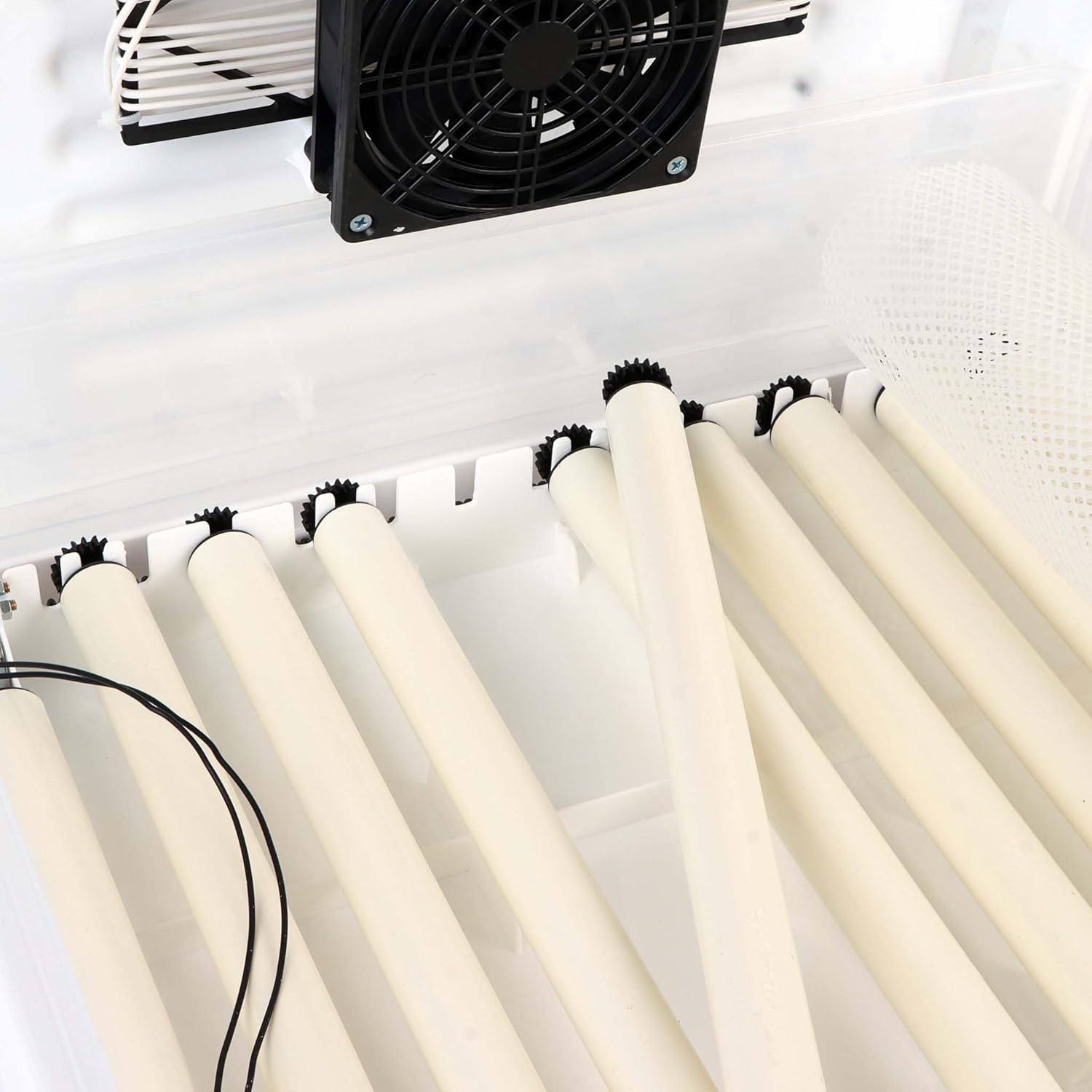
Mufananidzo: Kuvhara view of the internal egg turning rollers and the circulation fan within the incubator.

Image: An illustrative diagram highlighting the temperature and humidity display, and the flow of air and water within the incubator system.
5. Setup
- Kuiswa: Place the incubator on a flat, stable surface in a room with a consistent ambient temperature (ideally between 20-25°C / 68-77°F). Avoid direct sunlight, drafts, or areas with significant temperature fluctuations.
- Power Connection:
- Connect the AC power cable to the incubator and then to a standard wall outlet.
- For emergency power backup, connect the DC battery cable to the designated port on the incubator and the other end to a 12V battery (e.g., car battery). This ensures continuous operation during power outages.
- Humidity System Setup:
- Take a standard plastic water bottle (not included) and fill it with clean, distilled water.
- Screw the provided water bottle connection cap onto the filled bottle.
- Insert the thin tube from the connection cap into the designated inlet on the side of the incubator. This system will slowly and uniformly supply water to the internal humidity channels.
- Pre-heating: Plug in the incubator and allow it to run for at least 2-3 hours (preferably 24 hours) before placing eggs inside. This allows the internal temperature and humidity to stabilize.
6. Operating Instructions
This section guides you through the process of incubating eggs using your Fudajo incubator.
6.1. Kugadzika Tembiricha uye Hunyoro
- The incubator features an intelligent control system with two screens for monitoring. Refer to the specific buttons on the control panel to adjust the desired temperature and humidity levels according to the type of eggs you are incubating.
- Typical incubation temperatures for chicken eggs are around 37.5°C (99.5°F). Humidity levels vary depending on the stage ye incubation.
- The automatic humidity regulation system will draw water from the external bottle as needed. Monitor the water level in the external bottle and refill as necessary.
6.2. Egg Placement
- Carefully place up to 64 fertilized eggs onto the adjustable rolling trays. Ensure eggs are clean and free from cracks.
- The adjustable rollers can accommodate various egg sizes, from quail to goose eggs.
6.3. Automatic Egg Turning
The integrated reversible motor ensures that eggs are automatically turned at regular intervals. This prevents the embryo from sticking to the inside of the shell and promotes healthy development.

Image: A diagram illustrating the gears and rollers of the automatic egg turning mechanism, ensuring uniform rotation of eggs.
6.4. Candling
The incubator features an integrated candler to easily monitor the development of the embryo without disturbing the incubation process. Simply place an egg over the candler light to observe its contents.

Image: A visual representation of the integrated candler in use, showing different stages of embryo development visible through the eggshell.
6.5. Hatching Phase
Approximately 3 days before the expected hatch date, stop the automatic egg turning function. Increase the humidity level as recommended for your specific egg type to aid in hatching. Do not open the incubator frequently during this critical period.
7. Kuchengeta
- Kuchenesa: After each incubation cycle, unplug the incubator and allow it to cool. Clean all surfaces with a damp cloth and a mild disinfectant. Ensure all components are completely dry before storing or reusing.
- Kuchengeta: Store the incubator in a clean, dry place away from direct sunlight and extreme temperatures.
8. Kugadzirisa matambudziko
If you encounter issues with your incubator, refer to the following common problems and solutions:
- Temperature Fluctuations: Ensure the incubator is not in a drafty area or exposed to direct sunlight. Check that the fan is operating correctly.
- Matambudziko eHunyoro: Verify that the external water bottle is filled and properly connected, and that the tubing is not kinked. Ensure the internal water channels are not blocked.
- Eggs Not Turning: Check if the automatic turning function is enabled on the control panel. Ensure the egg rollers are properly seated and free from obstructions.
- Hapana Simba: Check the power cable connection to both the incubator and the wall outlet. If using emergency power, ensure the 12V battery is charged and correctly connected.
For persistent issues not covered here, please contact customer support.
9. Zvinotsanangurwa
| Feature | Tsanangudzo |
|---|---|
| Zviyero zveChigadzirwa (L x W x H) | 45 x 45 x 21.5 cm |
| Kurema | 2.96 makirogiramu |
| Simba | 110 W |
| Egg Capacity | Kusvikira mazai matatu |
| Material | Polypropylene (PP) |
| Model Number | 65587 |
| Mugadziri | Wiltec |
| Nyika Yekwakabva | China |

Image: Technical drawing indicating the dimensions of the Fudajo Fully Automatic Incubator.
10. Warranty uye Tsigiro
Specific warranty information and detailed customer support contacts are not provided within this manual. Please refer to your purchase documentation or the retailer's website for warranty details and customer service contact information.


